
NTT-Series Sub-Micron Ultra-Micro Classifier
Introduction
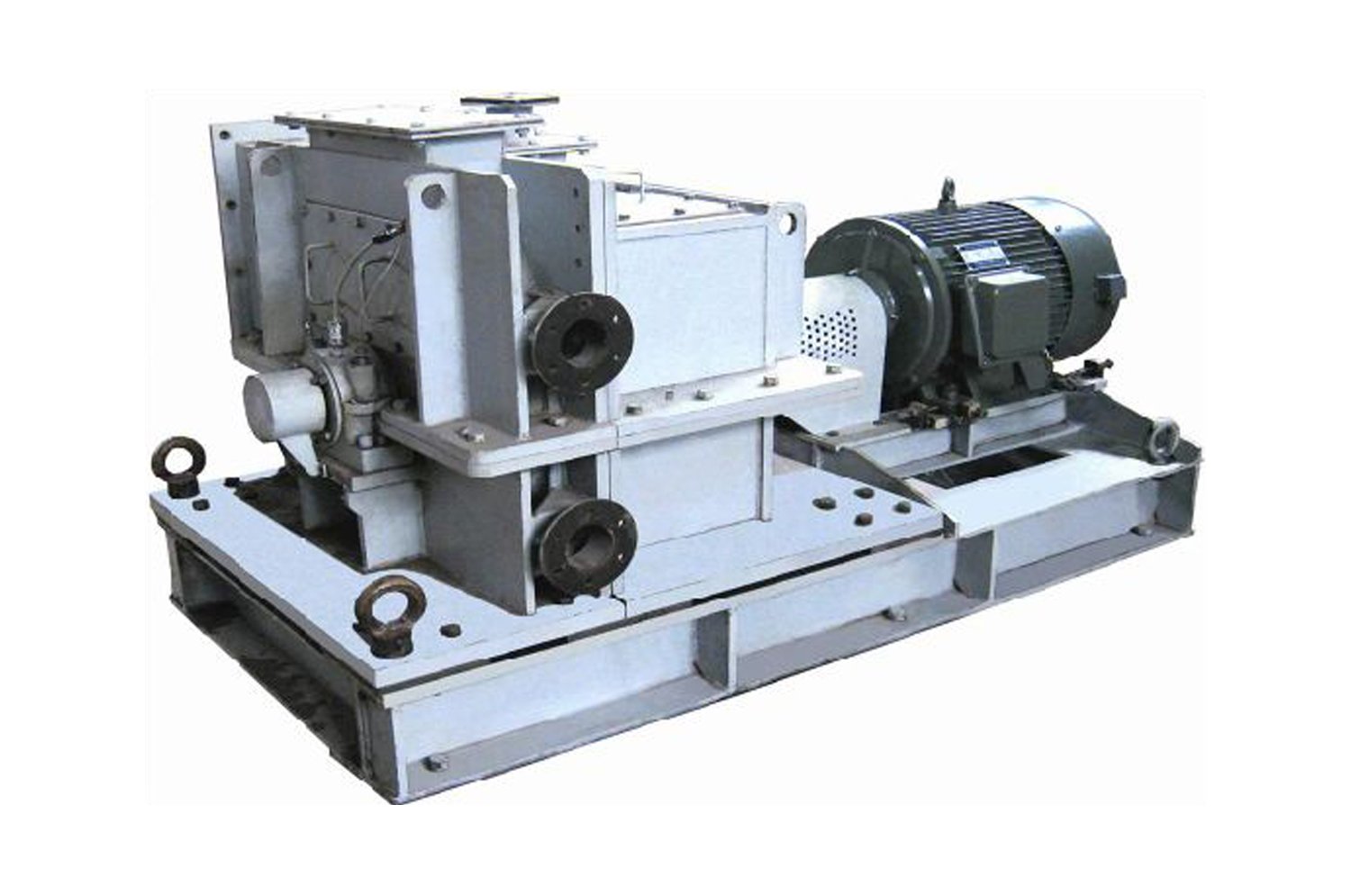
The NTT-Series Sub-Micron Ultra-Micro Classifier is a precision classification system specifically engineered for submicron ultra-fine powder production in the 1250 to 7000 mesh range. Using a strong rigid eddy current classification principle with a single horizontal impeller design, it delivers precise particle size cutting at the submicron level, where conventional classifiers cannot perform reliably.
A key innovation in the NTT-Series is the integrated spray impact dispersion technology applied before classification. This fully disperses agglomerated submicron powders prior to entering the classification zone, solving one of the most persistent challenges in submicron powder processing and ensuring clean, accurate particle size separation without coarse particle contamination in the final product.
Application Range
The NTT-Series Sub-Micron Ultra-Micro Classifier is designed for high-value submicron dry powder processing across a wide range of materials and industries. It is widely used in the processing of non-metallic mineral powders including kaolin, calcite, barite, and talc, with particular strength in calcined kaolin classification achieving precise D90 and D97 particle size control.
Beyond mineral processing, the NTT-Series serves ceramic powder production, pharmaceutical powder classification, pesticide and abrasive material processing, and any application requiring reliable and consistent classification in the 1250 to 7000 mesh range with controlled submicron output.
FEATURES AND CHARACTERISTICS
01.
Specifically Designed for Submicron Ultra-Fine Powder Classification
Engineered for submicron ultra-fine powder classification in the 1250 to 7000 mesh range, covering precision applications that standard classifiers cannot address.
02.
Strong Rigid Eddy Current Classification for Stable Submicron Separation
Uses a strong rigid eddy current classification principle with a single horizontal impeller structure, delivering stable and precise particle size separation consistently at the submicron level.
03.
Particularly Effective for Calcined Kaolin and Wet-Processed Submicron Products
Delivers exceptional performance in calcined kaolin classification with D90 recovery at 2 microns, and handles dispersion classification of submicron products produced by wet processing after drying.
04.
Integrated Spray Impact Dispersion Eliminates Agglomeration Before Classification
Integrated spray impact dispersion technology fully disperses raw materials before they enter the classification zone, resolving the agglomeration problems common in submicron powder processing and ensuring precise particle cutting without coarse particle entrainment.
05.
Consistent and Repeatable Output with No Coarse Particle
Delivers consistent and repeatable particle size output with no coarse particle contamination in the finished powder, making it suitable for high-value and precision applications.
SPECIFICATION DATA
Remarks:
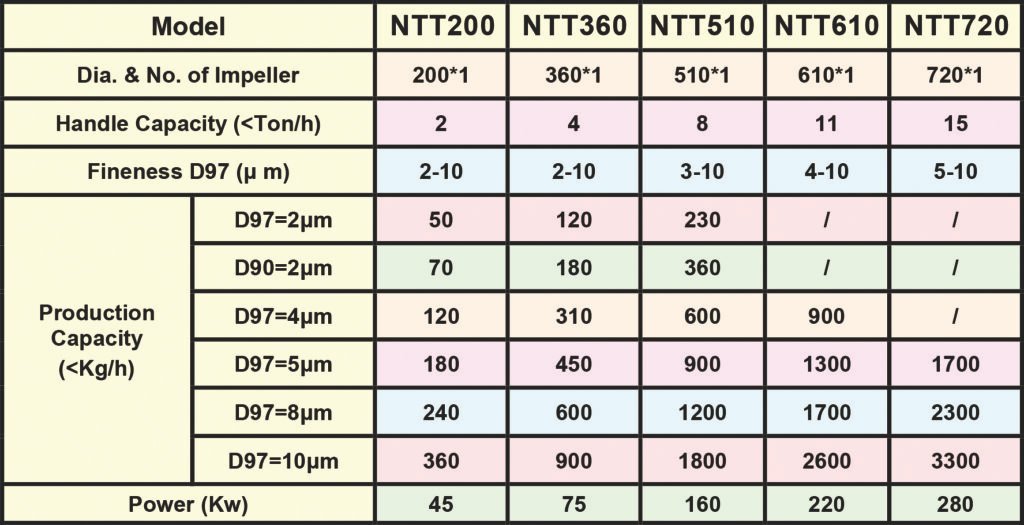
1. Output data for D97 below 5 microns is based on secondary classification of GCC powder above 800 mesh.
2. For raw materials containing more than 80% of 2 micron particles, classification performance is optimized when the 2 micron content increases by 10%.
R&D Experimental Base | National Powder Key Test Lab
In 2011, with state funding support, our institute established the NTT Sub-Micron Experimental Line as the R&D Center Experimental Base for ultra-fine submicron technology development. The facility was completed and put into operation in 2012.
This experimental base serves as a dedicated platform for technological research, equipment testing, and process innovation in ultra-fine powder classification. It provides the technical foundation for continuous improvement of our submicron classification systems and supports customers in evaluating material processability before committing to full-scale production line investment.
The experimental line is capable of flexibly classifying various materials across the 600 to 7000 mesh range, providing data-driven guidance for production line configuration, equipment selection, and material processing parameters. This capability allows us to deliver fully validated solutions to our customers rather than theoretical recommendations.
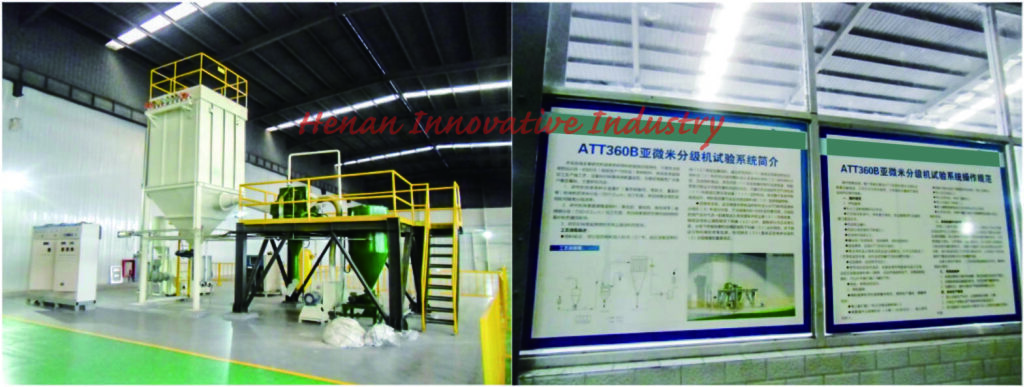
National R&D Center Experimental Base (Sub-micron Classifier Ultrafine Experimental Line)
Need a Sub-Micron Classifier for Your Operation?
Tell us your material type, required particle size, and production capacity. Our engineering team will recommend the right NTT-Series configuration and can arrange material testing at our R&D experimental base.